

The 2021 edition of the Home–Work Commute Plan (HWCP), drafted by the University Mobility Manager in collaboration with the Environmental Sustainability Unit, was approved by the Academic Senate on 19 July 2021 and by the Board of Governors on 27 July 2021.
The plan is the outcome of a participatory process involving several professional profiles who contributed to data collection and provided technical expertise.
Following an analysis of the relevant legislation, the document examines the territorial and infrastructural context of the campuses, with particular attention to available mobility options. This is followed by an analysis of transport demand based on the 2019 Mobility Survey.
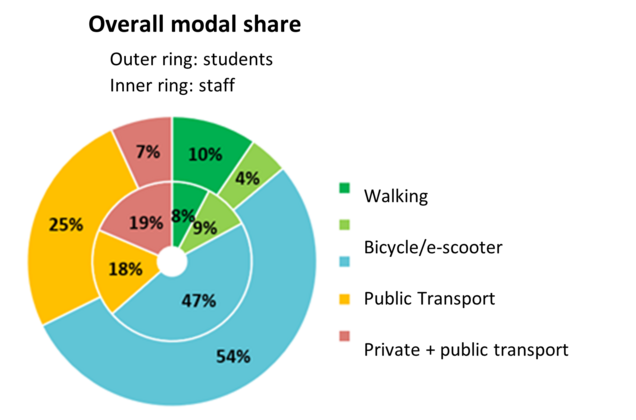
Based on the results of the survey, the plan identifies priority areas for intervention—namely the introduction of measures to reduce inbound flows to the University, infrastructural improvements, agreements and service provisions, and incentives and benefits—together with the specific actions proposed to promote sustainable mobility, after outlining the measures already implemented by the University.
The proposed actions aim to contribute to the achievement of the United Nations 2030 Agenda Sustainable Development Goals (SDGs) and to promote sustainable mobility choices by encouraging changes in individual behaviour and discouraging the use of private motorized vehicles, in line with the University’s CO₂ Emissions Mitigation Plan. The HWCP also includes several proposals for improving the areas surrounding the campuses, which were submitted to the relevant authorities in the summer of 2020.
The survey results presented in the HWCP highlight the need to adopt differentiated measures according to the distance travelled to reach Politecnico di Milano campuses. In particular, the following actions are identified:
- Commutes over 7 km:
- External measures: Collaboration with public and local public transport (PT/LPT) operators and institutions to introduce pay-per-use subscription schemes; Facilitation of bicycle access to train stations and trains by adapting infrastructure to cyclists’ needs; Promotion of provincial Bicycle Plans (Biciplan) to develop inter-municipal cycling connections to railway stations;
- Internal measures: Expansion of the categories of Polimi users eligible for public transport (PT/LPT) subscription subsidies and increase of the subsidy amount; Promotion of carpooling; Installation of electric vehicle charging points.
- Commutes under 7 km:
- External measures: Collaboration with public and local public transport (PT/LPT) operators and institutions to introduce pay-per-use subscription schemes; Engagement with local authorities to develop cycling infrastructure and implement traffic-calming measures in the areas surrounding the campuses;
- Internal measures: Installation of bicycle racks and creation of bike stations; Construction of showers and changing rooms; Allocation of mobility credits to users commuting between home and university by bicycle.
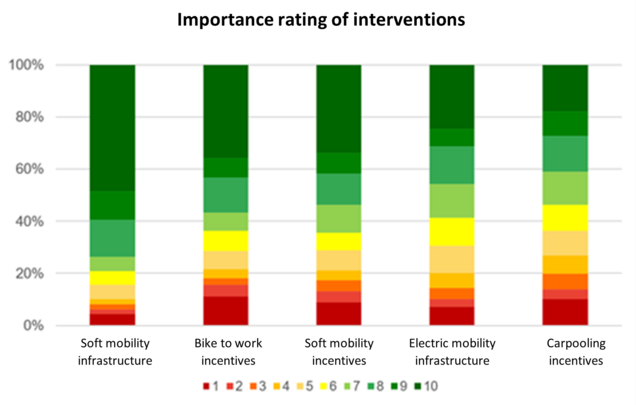
With regard to the measures directly under the responsibility of the University, an internal survey was conducted in September 2020 to assess the level of interest within the Politecnico community in the five actions identified as priorities. Respondents were asked to rate each action on a scale from 1 (not important) to 10 (very important). The survey results, presented in the figure below, show that interventions related to cycling are considered the most urgent. These include, first and foremost, infrastructure improvements—such as increasing the number of bicycle parking spaces and creating bike stations - followed by incentives for bike-to-work schemes and the introduction of cyclist-oriented services, including changing rooms equipped with showers.
Details of each priority action, for which a total investment of €1.5 million is planned, are outlined below.
- Infrastructure for cycling mobility (Projected investment: €550,000)
Proposal: construction of five bike stations with controlled access and equipped with bicycle repair facilities, in addition to the station already funded by the Sustainability Service and currently under construction at the Leonardo campus. The new bike stations are planned for the Bonardi, Bassini, Golgi, La Masa, and Candiani campuses. The proposal also includes the installation of additional bicycle racks/stands to reach a total of at least 1,300 bike parking spaces at the Leonardo campus, 600 at the Bovisa campus, and approximately 100 at each of the other campuses (500 in total). - Incentives for bike-to-work users (Projected investment: €400,000)
Proposal: introduction of a voluntary, certified tracking programme (e.g. the Pin Bike system) for Polimi employees commuting by bicycle, coupled with benefits and rewards such as discounts on products from Polishop’s Green Line. - Infrastructure and services for sustainable mobility (Projected investment: €250,000)
Proposal: construction of facilities equipped with showers and changing rooms, preferably located near the bike stations described in Action 1. The proposal also includes the creation of department-level showers and changing rooms. - Infrastructure for electric mobility (Projected investment: €200,000)
Proposal: installation of 20 additional electric vehicle charging points (columns/wall boxes), evenly distributed across the campuses, in addition to the 20 already funded and currently overseen by the Energy Commission. The proposal also includes the installation of 300 charging points for electric scooters and bicycles, to be located in study, refreshment, and recreational areas of the campuses, in addition to those recently installed at the Leonardo Gardens and the Leonardo bike station currently under construction. - Incentives for university carpooling (Projected investment: €100,000)
Proposal: introduction of benefits and rewards (e.g. discounts on Polishop’s Green Line products) for users of the Polimi carpooling service, which is currently in the testing phase.
Download
-
HWCP 2021 (Italian version)
PDF
-
Infographic (Italian Version)
PDF